End Seat or Corner Seat: What Changes in the View?
Compare an end seat with a corner seat to see how angle, distance and the direction of play change what you can follow across the pitch.
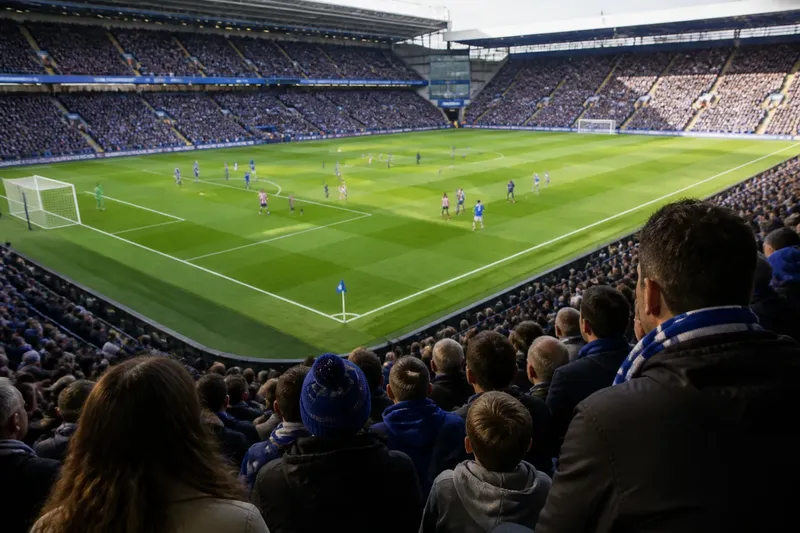
Choosing between an end seat and a corner seat changes how you read a match: an end seat faces attacks coming towards or away from you, while a corner seat opens more of the pitch at an angle. The right choice depends on whether you want to see goalmouth action close-up or follow play moving across the field.
Before buying, check the seat map, look at the pitch from the listed block, and ask what you most want to follow. A seat’s row and position within its block matter as well as its broad location. Use the routine below to compare views without assuming that every stadium, or every seat in a section, feels the same.
Start with the action you most want to follow
Think about the moments that make a match satisfying for you. If you watch for a striker’s movement, goalkeeper positioning and the instant a shot is taken, a seat behind a goal puts that end of the field directly in front of you. You see the goalmouth as a focused scene, with players closing in from the wider pitch.
If you prefer to track how an attack develops, a corner seat can make the routes between midfield and the penalty area easier to read. The diagonal view shows more of the field’s width than a seat directly behind the goal, although the far touchline and distant goal will still be farther away than the near end.
Choose one priority before comparing blocks. “I want to watch the whole build-up” is more useful than “I want a good view”, because it gives you a clear question to test against the seat map.
Compare the angle from behind the goal and the corner
From behind the goal, the pitch’s long axis points towards you. When play is at your end, players approach from the field and converge on the goal, so runs towards the box and the goalkeeper’s position can feel direct. The trade-off is that players spread across the width of the pitch appear compressed into a narrower view. A pass travelling across the field may look shorter or less obvious than it does from the side.
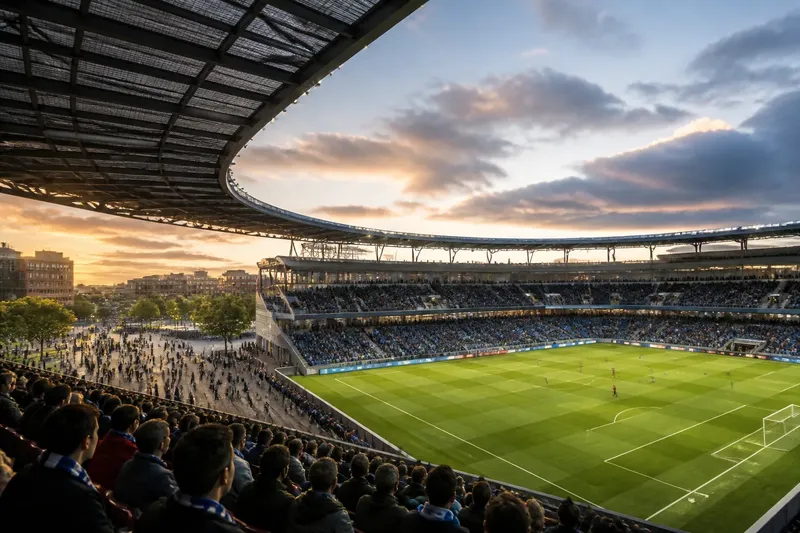
At the corner, the pitch sits diagonally in your view. You can see both the length and width at once, which helps when following a switch of play or a run along the near side. But the perspective is uneven: the near corner occupies more visual space, while the opposite end and far touchline recede. You may need to turn your attention across the pitch as the ball changes sides.
Don’t treat “corner” as a single viewing angle. A block close to the goal line can retain much of the end-on perspective; a block farther along the stand may offer a more side-on view. Check the block’s exact location rather than relying on its label.
Use a week to check seat information
A simple week-long comparison gives you time to look beyond a sales image. You do not need a complicated spreadsheet; a few notes on the block, row and view are enough.
- When you first look: Mark the end blocks and corner blocks on the official seating plan. Note which goal is nearest and whether the corner section runs along the end stand, the side stand or both.
- A day later: Find a view taken from the same stand and a similar row, if the club provides one. Check whether it shows the near goal, the far goal and the touchlines clearly. A promotional image from another level is not a reliable substitute.
- Midweek: Write down the match moments you care about most: finishing, defensive shape, passing lanes or movement along the wing. Match each priority to the angle rather than choosing by the photograph’s dramatic effect.
- Before you decide: Compare available row positions within each block. A lower row may bring the near goal closer but leave more of the far field at a steep angle; a higher row may open the overall view. The exact result depends on the stand’s shape.
- On purchase day: Recheck the seat plan and the section boundaries. If you cannot tell which direction the seat faces, ask the ticket office to clarify the location before choosing.
Say you want to watch how a team moves the ball from midfield into the penalty area, and you are choosing between a seat behind the goal and one in the adjacent corner. You could compare the corner’s row-level view with the end seat’s, then choose the corner if it keeps the midfield passing lanes visible. The observable difference to look for is whether you can follow the ball’s route across the pitch without losing the far-side players from view.
Think about distance as well as direction
End and corner seats can be close to the pitch, but proximity does not automatically mean a clearer view of every phase. From an end seat, the near goal may dominate your attention, while the far end looks small. At the corner, diagonal distance can make the near penalty area feel close and the opposite corner feel remote at the same time.
Ask how much of the match happens outside the nearest area. If you want to follow both teams’ shape while play is in midfield, a seat with a broader angle may make that easier, even if the near goal feels less immediate. If you mainly want to experience attacks at one end, a behind-goal seat may suit you better, especially when the team you support attacks towards that end for a substantial part of the match.
Also consider whether you tend to watch the ball or scan the players away from it. A narrow end-on view asks you to look across the width of the field when the ball is far from your end. A corner view gives you more of that width, but the diagonal can make it harder to judge distances between players. Neither angle removes the need to shift your gaze.
Check what changes from row to row
Within a section, moving higher or lower alters the relationship between the seat and the pitch. From a lower position, nearby players may feel larger and the action at your end more immediate. From higher up, the field’s layout may be easier to scan, though individual touches can feel less close. These are tendencies, not promises: stand geometry, barriers and the precise seat location all affect the view.
Look for practical obstructions in any seat-view image. A railing, camera position, support or nearby structure may interrupt a portion of the scene. Images can also be taken with a wide lens that makes the whole field appear more open than it feels to a seated spectator. When a view is unclear, ask the venue about that specific block and row.
Where seat access, a view obstruction or a particular facility matters, check the venue’s seat information and ask the ticket office; details vary by location.
Which end or corner view suits your priorities?
Is a seat behind the goal good for watching tactics?
It can show the spacing of attackers and defenders around the penalty area clearly, but the width of the pitch is compressed in an end-on view. For midfield shape and switches of play, a corner or more side-on angle may be easier to scan.
Can a corner seat show the whole pitch?
A corner seat gives a diagonal view across much of the field, but perspective makes the far end and far touchline look more distant. Check a view from the same block and row to judge whether the areas you care about remain easy to follow.
Does sitting higher improve the view?
A higher row may make formations and passing routes easier to read, while a lower row can make nearby action feel more immediate. Compare the actual seat views because the stand’s design determines how much the angle changes.
Which seat is better for seeing goals?
A seat behind a goal gives you a direct view of attempts at that end, while a corner seat lets you see the approach to goal from a diagonal. If you want to follow the whole attacking move as well as the finish, compare how each option shows the midfield and the far side.
Make the final choice from one clear priority
Use the same question for each available seat: what will be easiest to follow from here, and what will be hardest? Behind a goal, the goalmouth is the natural focus and play across the width may be compressed. At a corner, more of the pitch sits in view, but the diagonal stretches the distance to the far side.
For the best end seat or corner seat view, match the angle to your own way of watching, then verify the exact block and row. If your priority is the finish at one end, lean towards behind the goal; if it is the route of play across the pitch, compare corner seats with a clear diagonal view. Choose the seat whose compromise you will notice least during the match.